There’s something unsettling about turning on the kitchen tap and noticing that the water doesn’t look, smell, or taste quite right. Maybe there’s a rusty tint in the glass. Perhaps the water carries a strange “rotten egg” odor, or tiny particles settle at the bottom of a pitcher. These problems aren’t always dramatic, but they can be signs that your water needs a closer look.
Among the most common well-water concerns are iron, sulfur, and sediment. Each can affect water differently, and sometimes more than one appears at the same time. Understanding what’s happening is the first step toward choosing a sensible treatment approach rather than buying a filter and hoping for the best.
Why Well Water Can Develop Quality Problems
Groundwater naturally moves through layers of soil, rock, and minerals before reaching a private well. During that journey, it can pick up substances that aren’t necessarily visible at first.
Unlike treated municipal water, private well water usually isn’t continuously monitored by a public water utility. Its quality can change with seasons, groundwater conditions, nearby construction, flooding, or changes in the well itself.
That’s why two homes sitting only a short distance apart can have completely different water-quality issues.
Some households notice stains around sinks and toilets. Others struggle with unpleasant odors or cloudy water. And sometimes the water looks perfectly clear but still contains dissolved minerals or other contaminants that require testing to identify.
Understanding Iron in Household Water
Iron is one of those minerals that can become a nuisance long before it becomes an obvious problem.
Water containing dissolved iron may come out of the faucet looking clear and then develop an orange, brown, or reddish appearance after sitting in the air. Iron can also leave stubborn stains on bathroom fixtures, laundry, dishes, and porcelain surfaces. If you’ve ever scrubbed a bathtub only to see orange stains return a few days later, iron may be part of the story.
There are different forms of iron in water, and that distinction matters when selecting treatment equipment. Dissolved ferrous iron can pass through ordinary sediment filters because its particles are too small to be caught mechanically. Ferric iron, on the other hand, may already be oxidized and visible as suspended particles.
The treatment method should match the type and concentration of iron present. That’s one reason water testing is more useful than guessing based solely on appearance.
The Trouble With Sulfur Odors
Few water problems are as immediately recognizable as sulfur-related odor.
A strong rotten-egg smell is often associated with hydrogen sulfide gas. It can occur naturally in groundwater and may also be linked to certain bacteria that thrive in wells and plumbing systems.
The odor might be strongest when you first turn on a faucet, especially after water has been sitting in the pipes. In some homes, it becomes particularly noticeable when using hot water.
Interestingly, the smell doesn’t automatically tell you how severe the underlying water issue is. A small concentration can produce a surprisingly powerful odor. At the same time, odor can have several possible causes, so testing is important before deciding on a treatment strategy.
Depending on the situation, solutions may include aeration, oxidation and filtration, disinfection, or specialized treatment equipment. The right option depends on the water chemistry and where the problem originates.
Sediment: The Particles You Can Actually See
While some water contaminants are invisible, sediment tends to announce itself.
It can appear as sand, silt, clay, tiny particles, or cloudy material suspended in the water. Sediment may enter a well from groundwater conditions, disturbed soil, deteriorating well components, or changes in the surrounding environment.
Even when it isn’t harmful by itself, sediment can create plenty of headaches. It may clog faucets and showerheads, reduce the efficiency of appliances, wear out fixtures, and shorten the life of water-treatment equipment.
A properly selected sediment filter can help capture these particles before they travel throughout the home. But there’s a catch: not every sediment filter works equally well for every situation. Mesh size, filter capacity, flow rate, and the amount of material entering the water all matter.
If a filter seems to clog constantly, replacing it again and again may not be the real solution. The source and volume of sediment should be investigated.
When Iron, Sulfur, and Sediment Occur Together
Here’s where things can get a little complicated.
A household may experience rusty staining, sulfur odor, and visible particles at the same time. It’s tempting to assume that one filter can handle everything, but water treatment rarely works that simply.
Different contaminants behave differently. A sediment filter may remove suspended particles but do little for dissolved iron. An iron filter might address certain forms of iron while leaving other concerns untouched. Likewise, a sulfur odor may require a treatment process designed specifically for hydrogen sulfide or sulfur-producing bacteria.
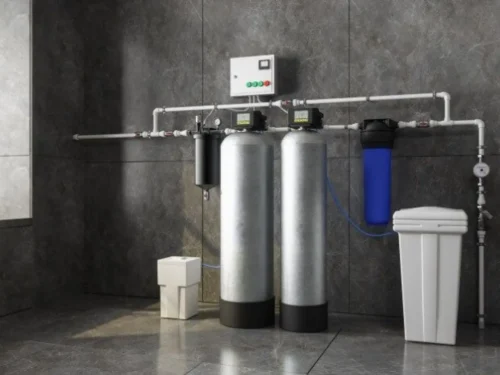
This is why a whole-house treatment system is often designed as a sequence of stages. For example, one component may handle larger particles, another may oxidize dissolved minerals, and another may provide additional filtration.
The order matters, too. Good treatment isn’t just about adding equipment; it’s about making the equipment work together.
Start With a Water Test
Before investing in a treatment system, test the water.
A basic water analysis can help identify the concentration of iron, manganese, hardness, pH, and other characteristics that influence treatment. If there are concerns about bacteria or other contaminants, additional testing may be appropriate.
Testing is particularly important for private well owners because water quality can change over time. A test from several years ago may not accurately represent what’s coming from the well today.
It’s also worth paying attention to changes. If your water suddenly develops an odor, unusual color, or heavy sediment, don’t simply assume it’s normal. A change can be useful information about what’s happening underground or inside the well system.
Choosing the Right Treatment Approach
There isn’t a universal “best” water filter. The best system is the one that matches the actual water conditions in your home.
Factors such as contaminant levels, water usage, well production, plumbing configuration, available space, and maintenance requirements should all be considered. A system that works beautifully for one household might perform poorly in another.
For some homes, a straightforward sediment filter is enough. Others may need iron and sulfur treatment, softening, oxidation, carbon filtration, or a combination of technologies.
Maintenance shouldn’t be overlooked, either. Filters need replacing, media may require servicing, and some systems need periodic cleaning or regeneration. A treatment system only performs well when it’s properly maintained.
Better Water Starts With Knowing What’s in It
Water problems have a way of becoming part of everyday life. You notice the smell but get used to it. You scrub the stains because, well, what else can you do? You replace a clogged filter and move on.
But you don’t necessarily have to live with those frustrations.
Iron, sulfur, and sediment are common water-quality challenges, especially for private wells, and modern treatment technologies can often make a noticeable difference. The important part is not rushing toward the first product advertised as a cure-all.
Test the water. Understand the source of the problem. Then choose a treatment approach based on evidence rather than guesswork.
Clean, pleasant water shouldn’t feel like a luxury. For most households, it’s simply one of those everyday comforts you appreciate most when it finally works the way it should.